



When people ask what Persephone is the goddess of, they often expect a clear label. Yet her meaning reveals itself through movement rather than definition. Persephone lives between light and darkness, descent and return.
Her story speaks to inner seasons of pause and change. It offers a way to understand transformation that unfolds through both loss and renewal, especially within the feminine experience.
1. A Simple Answer: What Persephone Is the Goddess Of
1.1 Goddess of Spring and Renewal
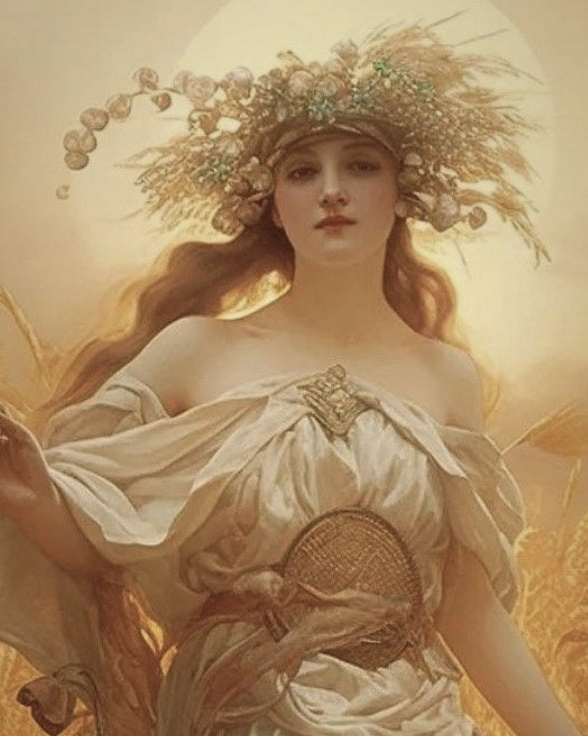
In Greek mythology, Persephone first appears as a maiden of spring, living in close bond with her mother Demeter, the goddess of harvest and nourishment. She moves through fields, gathers flowers, and exists in a world where life feels continuous, protected, and abundant. This is the Persephone of early spring—untouched, open, and rooted in innocence.
When Persephone walks the earth, the land responds. Seeds sprout. Green returns. Her presence signals that life is willing to begin again. In this role, she governs renewal not as force, but as natural re-emergence. Nothing is pushed. Nothing is rushed. Growth unfolds because the time is right.
Spiritually, this aspect of Persephone reflects the feminine state of readiness—the moment after inner stillness when energy turns outward again. It mirrors the phase of life when a woman feels safe enough to hope, to create, and to say yes after a period of retreat. Spring does not erase what came before. It rises because the ground has rested.
1.2 Queen of the Underworld
Persephone’s story does not end in the fields. Through her descent into the underworld, she enters a realm that few gods willingly inhabit. The underworld in Greek myth is not simply a place of death. It is the domain of memory, truth, and what cannot be ignored.
Over time, Persephone does not remain a captive. She learns the structure of the underworld. She understands its laws. She becomes its queen. This transformation is essential to her meaning. As ruler, she holds authority over cycles of life and death, over endings that make space for return.
As Queen of the Underworld, Persephone governs depth. She presides over what has been buried—grief, loss, longing, and unspoken knowledge. Nothing here is ornamental. Everything is real. Her power lies in her capacity to remain present where others turn away.
By holding both spring and the underworld, Persephone becomes a bridge. She embodies awareness that includes innocence and experience, light and shadow. She does not abandon one world for the other. She stands in relationship to both.
| Aspect | Domain | Meaning |
| Spring | Renewal | Growth, return of life, and the reawakening of hope |
| Underworld | Shadow | Depth, truth, and the integration of what was hidden |
2. Why Persephone Rules Two Worlds
Persephone’s authority over two worlds begins with a single myth. Her rule is not granted at birth, but shaped through a sequence of events that carry her from the surface of the earth into the depths below. The story of her descent and return explains how this dual role came into being.
2.1 The Myth of Descent and Return
In Greek mythology, Persephone was the daughter of Demeter, the goddess of grain and fertility. One day, while Persephone was gathering flowers in a meadow, the earth suddenly opened. Hades, ruler of the underworld, emerged and carried her away to his realm beneath the ground.
Demeter searched endlessly for her daughter. In her grief, she neglected the earth. Crops withered, the land grew barren, and famine spread among mortals. Seeing this, Zeus intervened and ordered that Persephone be returned.
Hades agreed, but before Persephone left the underworld, she ate several seeds of a pomegranate. Because of this, she could not fully leave his realm. A compromise was reached: Persephone would spend part of the year in the underworld with Hades, and part of the year on earth with Demeter.
Each year, when Persephone returns to the surface, Demeter restores fertility to the land. When Persephone descends again, the earth falls into dormancy. Thus, Persephone comes to dwell between two worlds, moving between them in an endless cycle.
2.2 The Power of Choice and Initiation
The pomegranate plays a central role in Persephone’s fate. In the underworld, Hades offered her the fruit, and she ate its seeds. According to ancient law, anyone who consumed food in the underworld was bound to it.
Because Persephone had eaten the pomegranate, her return to the upper world could not be permanent. From that moment on, her life was divided between two realms. She was no longer only the daughter who lived in her mother’s care, but the queen who ruled beside Hades.
Through this act, Persephone’s place among the gods was altered forever, and her story became one of descent, return, and rule across two worlds.
3. Persephone as the Goddess of Rebirth
Persephone’s connection to rebirth begins with an ending. Before renewal becomes possible, something must first come to a close.
3.1 Death as a Metaphor for Change
In Persephone’s mythology, death rarely arrives as a dramatic collapse. More often, it appears as a quiet ending. Something that once defined life no longer fits, yet nothing new feels solid enough to replace it.
For many women, this “death” shows up during concrete life moments. A relationship ends and the version of herself who existed within it dissolves. A career path closes, leaving behind years of identity and effort. Becoming a mother, leaving a marriage, moving to a new country, or losing a parent can all mark the end of a familiar inner structure.
During these phases, women often feel suspended. Energy drops. Direction fades. Motivation feels distant. This is not failure. It is a natural pause between identities. Persephone’s descent names this space—a period when life moves inward, and the old self must be released before the new one can emerge.
3.2 Rebirth in Feminine Cycles
Persephone’s rebirth does not follow a straight path, and neither does a woman’s growth. In real life, change rarely moves forward in a clean line. It spirals. It circles back. It revisits familiar emotions, old questions, and unfinished feelings—each time from a slightly different place.
Many women recognize this pattern intimately. You may think you have moved on from a breakup, only to feel its weight again months later. You may feel strong and clear in one season, then suddenly uncertain in the next. You may leave an old role behind—daughter, partner, professional—and find yourself grieving it long after the decision was made.
This does not mean you are stuck. It means you are integrating.
Feminine growth often moves like a spiral: returning to similar themes, but with more awareness, more capacity, and more choice each time. What once overwhelmed you may still touch you, but it no longer defines you in the same way. What once confused you may still arise, but now you recognize it faster.
Rebirth, in this sense, is not a dramatic transformation that happens once. It is a series of quiet returns—to yourself, to your body, to your inner truth. Each cycle brings you forward, even when it feels like you are revisiting old ground.
Persephone’s rhythm affirms this way of becoming. She does not stay in spring forever. She does not abandon the underworld once she leaves it. She moves between them, and through that movement, life continues.
4. Persephone and the Feminine Shadow
Beyond rebirth and renewal, Persephone’s time in the underworld reveals another layer of her story. It draws attention to what women carry quietly—experiences that shape their inner world long before they are named.
4.1 What the Underworld Represents for Women
For many women, the underworld begins forming early. It starts the first time anger is met with disapproval. The first time sadness is rushed away. The first time desire is judged or ignored. Slowly, a woman learns which parts of herself are welcome—and which must be kept out of sight.
In adulthood, this shadow often lives in ordinary moments. It appears when a woman says “it’s fine” while feeling hurt. When she continues to give in relationships long after her energy is gone. When she stays silent in meetings despite knowing she has something valuable to say. When she feels resentment toward the very people she loves, and then feels shame for having that resentment at all.
These experiences do not mean something is wrong with her. They mean she has adapted. The underworld becomes the place where truth waits when it has nowhere else to go.
4.2 Why Persephone Is a Shadow Work Archetype
What makes Persephone different is that she does not try to purify the underworld. She does not demand that emotions become acceptable before they are allowed to exist. As queen, she stays present with what is uncomfortable, unpolished, and unresolved.
Shadow work in Persephone’s way is deeply practical. It looks like noticing tension in the body before words appear. It looks like allowing anger to be felt without immediately turning it into blame or action. It looks like admitting disappointment without justifying it. It looks like letting desire surface without rushing to suppress or explain it.
Over time, this presence changes the relationship to the shadow. What was once overwhelming becomes familiar. What was once feared becomes informative. The underworld does not disappear—but it no longer controls life from beneath the surface.
5. What Persephone Means for Modern Women
Persephone’s mythology does not belong only to ancient stories. It continues to surface in modern women’s lives, especially during moments when identity feels unstable and certainty fades.
5.1 Life Transitions and Identity Shifts
For many modern women, Persephone appears during moments when life quietly rearranges itself. A long relationship ends, and the future that once felt secure disappears. A career built with years of effort no longer fits. Motherhood arrives and reshapes time, body, and priorities in ways no one fully prepared her for.
These transitions are often accompanied by a subtle but unsettling question: Who am I now? Not because something went wrong, but because the old answer no longer applies.
Women in their thirties and beyond frequently experience this shift. The identities that once provided structure—student, partner, achiever, caretaker—begin to loosen. There is a sense of standing between versions of the self. Outwardly, life continues. Internally, something feels suspended.
This in-between state can feel lonely. It is rarely acknowledged or named. Persephone’s story gives form to this experience—a period when the familiar dissolves before the new takes shape.
5.2 Owning Your Inner Seasons
Modern culture often encourages women to move forward quickly—to recover, to adapt, to improve. Inner winter is treated as a problem to fix. Persephone offers a different orientation.
She reminds us that every woman moves through inner seasons. There are times of clarity and expansion, and times of contraction and rest. There are phases when energy rises naturally, and phases when it retreats inward.
Owning your inner seasons means recognizing that withdrawal is not weakness. Confusion is not regression. Needing time does not mean falling behind. A woman may feel strong one year and uncertain the next, productive one month and deeply reflective the next.
Persephone teaches that these rhythms are not obstacles to growth. They are the way growth happens. When inner winter is allowed its time, spring arrives with greater depth and honesty.
5.3 When Stability Reveals Old Wounds
For many women, a surprising shift happens after life becomes stable. The relationship is steady. The work is predictable. Daily routines feel secure. From the outside, things finally look “settled.”
And yet, this is often when old emotional patterns begin to surface.
Childhood memories return unexpectedly. Sensitivities feel sharper. Reactions feel disproportionate. A comment from a partner triggers deep fear of abandonment. A small conflict awakens a familiar sense of shame. A quiet moment brings sadness with no obvious cause.
This is not regression. It is timing.
When survival is no longer the priority, the psyche gains space to process what was postponed. Many women grew up learning to adapt early—to be responsible, emotionally contained, or helpful. Those adaptations worked. They created stability. But they also buried unmet needs and unexpressed pain.
Persephone’s descent helps explain this phase. When the external world is no longer demanding all attention, the underworld opens again. Not to punish, but to be acknowledged. What rises now does so because it finally can.
6. Which Goddess Archetype Are You?
As Persephone’s story shows, not every inner struggle points to the same need. Different phases of life awaken different inner patterns, and recognizing which one is active can bring relief rather than judgment.
6.1 Why Persephone Resonates With Some Women More Than Others
Many women quietly ask themselves similar questions. Am I too rational? Am I too dependent? Why do I keep accommodating others even when it costs me?
These questions are rarely about flaws. More often, they reflect which inner archetype learned to lead at a certain time in life.
Some women learned early that thinking clearly and staying composed kept them safe. Athena energy becomes dominant. Logic replaces emotion. Control replaces vulnerability.
Some learned that staying connected was essential. Aphrodite energy leads. Relationships, harmony, and closeness take priority, even when boundaries blur.
Others adapted by yielding. Persephone energy forms early. Sensitivity, attunement, and responsiveness help them survive environments where asserting needs felt risky.
These patterns often trace back to childhood, not as conscious choices, but as intelligent adaptations. What once protected you may still be shaping your reactions today.
Persephone tends to resonate most strongly when these early patterns resurface—especially after life becomes stable enough for old material to rise. Her presence signals a phase of re-examining how you relate, choose, and respond, not because something is wrong, but because something deeper is ready to be seen.
6.2 Take the Goddess Archetype Quiz
If you find yourself recognizing pieces of your story here, you may be curious which archetype is most active for you right now. A gentle archetype quiz can offer language for what you are already sensing—without labeling you or placing you in a fixed category.
7. Working With Persephone Energy in Daily Life
Persephone energy does not require dramatic rituals or spiritual expertise. It is often met through simple, everyday choices that create enough safety for inner movement to unfold.
7.1 Rituals, Reflection, and Intentions
Working with Persephone energy begins with slowing down how you respond to yourself. During emotional low points, this may look like allowing a quiet evening instead of pushing productivity. Choosing rest without needing to justify it. Writing a few honest lines in a notebook, not to solve anything, but to let thoughts land somewhere safe.
During periods when childhood memories or old emotional patterns resurface, gentleness becomes essential. You may notice stronger reactions, deeper sadness, or unexpected fatigue. On these days, the practice is not insight, but containment. Eating regularly. Going to bed earlier. Reducing unnecessary stimulation. Letting emotions move through the body without forcing meaning.
When life feels stable, Persephone energy can still be honored through small acts of awareness. Checking in with yourself before agreeing to plans. Noticing when your body tightens or relaxes. Allowing moments of inward listening even when nothing feels “wrong.”
These are not rituals meant to create change. They are practices that allow change to happen naturally.
7.2 Symbols and Jewelry as Anchors
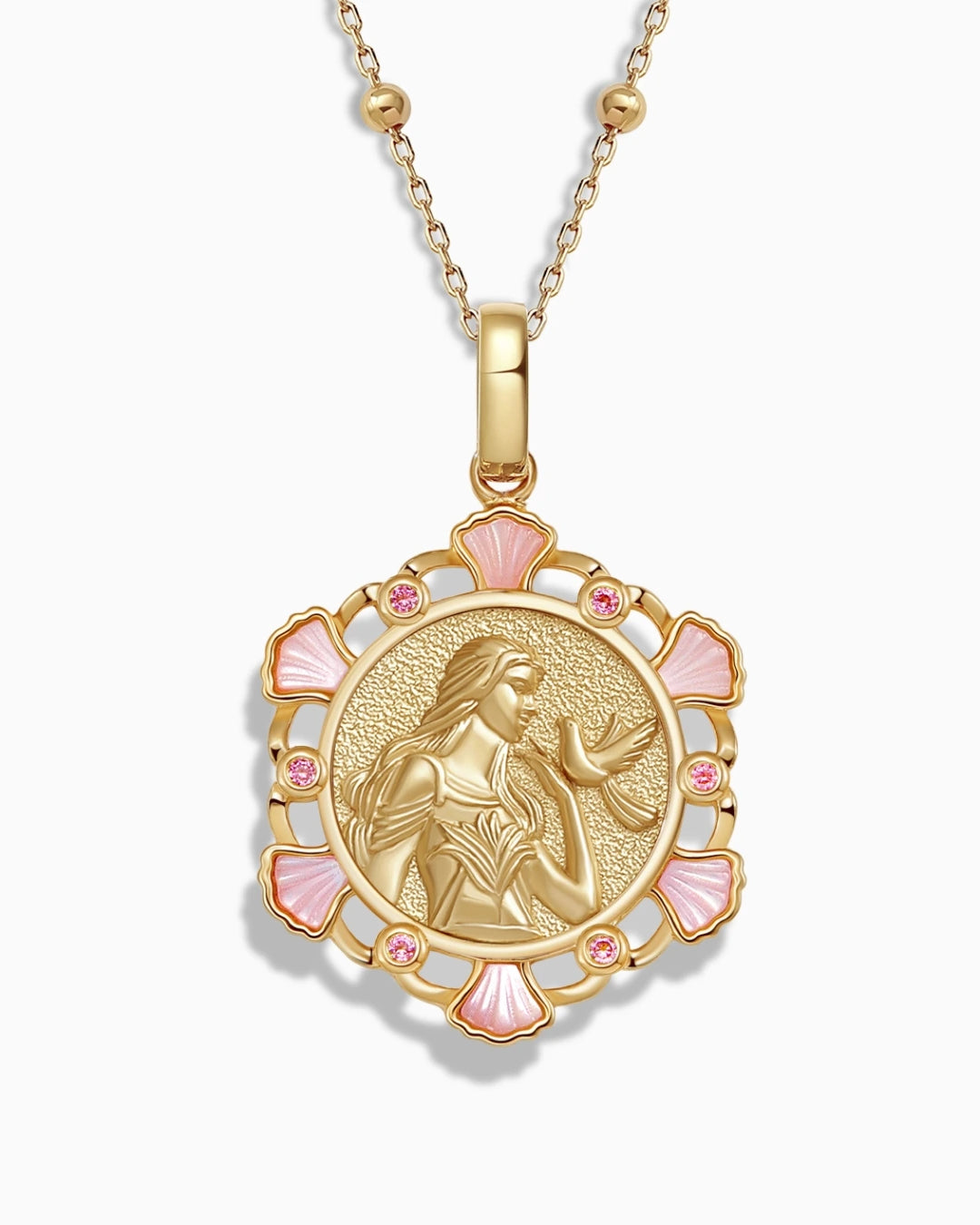
VidaWheel creates goddess jewelry as symbolic tools, helping women stay connected to their inner cycles.
During periods of inner transition, tangible objects can help anchor awareness. A symbol worn close to the body can serve as a quiet reminder of continuity—especially when emotions feel fragmented or cyclical.
Some women choose to work with Persephone symbols through jewelry, not as decoration, but as presence. A necklace worn during a difficult conversation, a transition, or a reflective walk can become a personal marker of inner timing.
VidaWheel creates goddess jewelry as symbolic tools rather than statements. The intention is not to define an identity, but to support presence—offering something steady to return to while inner seasons shift.
8. Persephone Necklace Meaning: Choosing the Symbol That Matches Your Journey
For the Persephone collection, VidaWheel translated myth into form by focusing on two distinct moments of the journey. One design speaks to descent and inner reorganization, using underworld symbols to hold endings and shadow. The other reflects return and early renewal, using spring imagery to mark the first signs of movement back toward life. Rather than offering one meaning, VidaWheel created two symbolic anchors—each aligned with a different phase a woman may be living through.
8.1 Persephone Rebirth Necklace
The Persephone Rebirth Necklace draws directly from underworld symbolism. Its central motif is the skull, paired with the pomegranate—two images closely associated with Persephone’s descent.
The skull is not used here as a symbol of danger or darkness, but as a marker of endings that cannot be avoided. It reflects the moment when an old identity has already dissolved. What once defined life no longer holds, even if the next form has not yet appeared.
The pomegranate appears alongside the skull to mark continuity. In Persephone’s myth, it is the fruit that binds her to the underworld while also securing her eventual return. In design terms, it holds the tension between loss and survival—what has ended, and what still carries life.
This combination tends to resonate during phases of deep inner work: after separation, during grief, or in periods when childhood material and long-buried emotions surface. The Rebirth Necklace does not signal readiness to move forward. It reflects readiness to stay present with what is real.
8.2 Persephone Spring Necklace
The Persephone Spring Necklace centers on the narcissus, traditionally recognized as one of the first flowers to bloom after winter. Its appearance signals the return of life, often emerging while the ground is still cold and the landscape largely bare.
In Persephone’s myth, the narcissus marks the threshold moment—when attention turns outward again, just before descent. In design, this flower carries the meaning of early re-emergence. Not full bloom, but the first sign that life is willing to rise.
The pomegranate remains present, holding memory. It reflects where Persephone has been, even as she steps back into light. Together, the narcissus and pomegranate express a specific phase: returning to the world with awareness, before certainty, before momentum.
This design often resonates when a woman feels the earliest signs of renewal. Energy is fragile but real. Curiosity returns. Connection feels possible again, without pressure to be fully “ready.”
9. Explore the Persephone Goddess Collection
Persephone’s journey does not move in a single direction. Descent and return exist as part of the same rhythm, and different symbols speak to different moments within that cycle.From Descent to Bloom
The Persephone Goddess Collection reflects the full arc of her mythology—from descent into the underworld to re-emergence in spring. Each piece corresponds to a distinct phase of transformation, offering symbolic support rather than a fixed meaning.
There is no “right” choice within the collection. What matters is resonance with where you are now.
10. FAQ
What is Persephone mainly the goddess of?
Persephone is mainly the goddess of transformation. She governs the movement between states—between innocence and awareness, loss and renewal, descent and return. Rather than representing a single domain, she holds the process of change itself, especially the kind that unfolds through cycles rather than straight progress.
Is Persephone the goddess of death?
Persephone is not the goddess of death. She rules the underworld as its queen, but her role centers on transition rather than finality. In myth, death under her domain is a passage, not an endpoint. Her presence emphasizes continuity between endings and beginnings rather than permanent loss.
Why is Persephone associated with spring?
Persephone is associated with spring because her return from the underworld marks the renewal of life on earth. Her presence signals the reawakening of growth after dormancy. Symbolically, she represents the moment when life begins to rise again, even while carrying the memory of what came before.
What does Persephone represent for women today?
For modern women, Persephone represents periods of identity change, emotional depth, and inner reorganization. She reflects experiences such as transition, healing, and revisiting early patterns after stability is reached. Her story offers a framework for understanding change without self-judgment.
Can wearing Persephone jewelry support healing?
Jewelry associated with Persephone does not heal on its own, but symbols can support awareness and presence. When worn with intention, such pieces may serve as reminders of cycles, inner timing, and continuity—helping women stay connected to where they are rather than where they feel they should be.

