To awaken Aphrodite is not about becoming someone else. It is about remembering a part of yourself that may have been muted, disciplined, or delayed.
Across cultures and time, Aphrodite has appeared whenever women needed to reclaim their right to feel, to desire, and to create from within. She is not a fantasy figure, but a living archetype that surfaces during moments of inner reawakening.
1. Who is the Aphrodite Goddess?
Aphrodite is often described as the goddess of love and beauty. But in the deeper feminine archetype system, she represents emotional sovereignty and a woman’s sacred alchemical power.
She is the part of a woman that feels deeply, desires honestly, and chooses pleasure without guilt.
Her power does not come from being admired.
It comes from being fully alive inside her own body.
Aphrodite carries the feminine ability to transform raw emotion into creation, to turn desire into beauty, and to refine love into self-wholeness.
Aphrodite energy appears when a woman allows herself to want, to feel, and to create— not to please, not to perform, but to alchemize her inner truth into life itself, without asking for permission.
2. The Divine Story in Myth
To understand Aphrodite’s power, it is essential to return to her myth—not as a romantic fantasy, but as a living story of emergence, desire, and transformation.
Her divine narrative unfolds through three essential movements: birth without lineage, desire as sacred force, and love that refuses containment.
3. Why Aphrodite is More Than Just a Myth in Modern Life
To understand Aphrodite’s power, it is essential to return to her myth—not as a romantic fantasy, but as a living story of emergence, desire, and transformation.
Her divine narrative unfolds through three essential movements: birth without lineage, desire as sacred force, and love that refuses containment.
3.1 Birth without lineage
Aphrodite is born not from a mother’s womb, but from the sea itself, and her origin begins with rupture rather than harmony. In the earliest Greek myths, when Uranus, the sky god, is overthrown and severed, his divine essence falls into the open ocean.
Blood, foam, salt, and living water churn together, and from this violent dissolution something entirely new takes form. The sea swells and breaks, and from this liminal space—where destruction has not yet settled and creation has already begun—Aphrodite rises.
She does not arrive as a child who must grow into her power. She emerges already whole, fully formed, radiant, and alive. There is no maternal lineage to shape her destiny and no father to assign her role within a cosmic order.
Her birth establishes a different law of existence: Aphrodite does not belong to hierarchy, inheritance, or control. She belongs to raw life force itself—the pulse that continues even after collapse, the beauty that appears not in spite of destruction, but because life insists on renewing itself through it.
3.2 Desire as sacred force
Where Aphrodite moves through the world, desire awakens—not as hunger or lack, but as a creative force that reshapes both gods and mortals. In Greek myth, her presence dissolves fixed boundaries and unsettles established orders. When Aphrodite unites with Ares, love and war collapse into one another, and from their tension are born Eros and Harmonia—desire and harmony emerging not from peace, but from conflict transformed. Creation, in her myth, does not arise from stability, but from intensity refined.
Even resistance to Aphrodite reveals her power. When Hippolytus rejects her and denies desire in the name of purity and control, the result is not transcendence, but destruction. His tragedy exposes a deeper law woven through her myths: what is suppressed cannot be integrated, and what is denied will return distorted and violent. Aphrodite does not impose desire; she reveals its inevitability as a force of life.
Her stories are filled with unions that ignite wars, inspire poets, fracture loyalties, and rearrange destinies. This is often misread as chaos or excess. Yet within the feminine archetype system, Aphrodite’s desire functions as sacred alchemy. She dissolves what has grown rigid or lifeless and transforms raw emotion into creation, longing into beauty, and attraction into generative movement. Once her desire has moved through a life, nothing remains unchanged, because desire, in its sacred form, is the engine through which transformation becomes possible.
3.3 Love that refuses containment
Despite being the goddess of love, Aphrodite is never owned by love. In Greek myth, she is formally bound in marriage to Hephaestus, a union arranged not by desire but by order and utility. The marriage does not tame her, nor does it define her. Aphrodite continues to choose her lovers freely, most famously Ares, the god of war, not in secrecy born of shame, but as an expression of her irreducible nature. Even when their affair is exposed before the gods, it is not Aphrodite who is diminished. The ridicule reveals the limits of a world that tries to contain love within rules it cannot obey.
Her myth does not present fidelity as obedience or virtue as submission. It presents love as sovereignty. Aphrodite does not exist to stabilize alliances, preserve structures, or protect moral order. She exists to keep life moving, to prevent stagnation, to reintroduce desire where systems grow rigid and bloodless. Through her, love is not a reward for good behavior nor a contract to be enforced. It is a living force that demands presence, truth, and transformation. Those who try to possess it lose it. Those who attempt to control it are undone by it. Aphrodite remains untouched—not because she avoids love, but because she embodies it as freedom itself.
4. The Vidawheel Reimagining: Aphrodite as Emotional Liberation
Within the Vidawheel feminine archetype system, Aphrodite is no longer reduced to a symbol of beauty, romance, or external attraction. She is reimagined as a force of emotional liberation—a living expression of feminine sovereignty that begins from within. This reinterpretation does not remove desire from Aphrodite’s mythology, but restores it to its rightful place as a source of power rather than a liability. Aphrodite, in this view, is not what is looked at, chosen, or consumed. She is what chooses, feels, and creates.
4.1 Beyond the "Goddess of Beauty" Label
From a feminine inner energy perspective, Aphrodite refuses objectification. Her magnetism does not arise from conformity to beauty standards or from the performance of desirability. It arises from honesty with her own desire. She does not shape herself to be wanted; she allows herself to want. This distinction is essential. In a culture that often rewards women for being pleasing while punishing them for desiring, Aphrodite stands in direct opposition to the moralization and demonization of feminine longing.
To reclaim Aphrodite is to reclaim desire as neutral, natural, and intelligent. It is to recognize that wanting does not make a woman dangerous, excessive, or irresponsible. It makes her alive. Vidawheel’s Aphrodite does not apologize for attraction, sensuality, or emotional depth. She reclaims them as signals of inner truth rather than flaws to be corrected.
4.2 Healing the Heart Center
In modern life, many women learn to regulate their worth through others’ responses. They become attuned to expectations, needs, and emotional climates, often at the cost of their own inner truth. This pattern is commonly described as the “pleasing self”—a mode of relating that prioritizes harmony over authenticity and acceptance over desire. Aphrodite offers a different pathway.
By reconnecting women to the heart center, Aphrodite energy supports a shift from pleasing others to enjoying oneself. This is not selfishness, but regulation. When the heart is allowed to feel freely, love and creativity re-emerge as the strongest life forces. Desire no longer seeks permission. Emotion no longer needs justification. From this state, creation becomes natural, and freedom is no longer something to be earned—it is embodied.
5. The Alchemy of Transformation: From Artemis/Athena to Aphrodite
Within the seven-goddess system, Aphrodite is rarely the starting point. More often, she emerges through transformation. Many women first develop strength through independence or intellect, learning to survive by holding boundaries or mastering logic. Artemis and Athena energies are often activated in response to a world that feels unsafe, demanding, or dismissive of feminine needs. The movement toward Aphrodite is not a rejection of these strengths, but an alchemical softening—a shift from protection to presence, from control to embodiment.
5.1 Softening the Warrior's Shield (Artemis → Aphrodite)
Artemis excels in independence, clarity of boundaries, and self-protection. She teaches a woman how to stand alone, how to say no, and how to guard her space. Yet when Artemis energy dominates for too long, it can quietly isolate intimacy. The shield that once ensured safety may begin to block closeness, tenderness, and the ability to receive care.
The transition from Artemis to Aphrodite does not dismantle boundaries; it relaxes them. Aphrodite invites the warrior to soften without losing strength, to remain sovereign while allowing herself to be seen and loved. In this alchemy, independence is no longer opposed to intimacy. Strength learns to coexist with openness, and protection gives way to trust rooted in self-worth.
5.2 Moving from Logic to Feeling (Athena → Aphrodite)
Athena offers clarity, strategy, and rational mastery. She helps a woman think her way through challenges, make sound decisions, and remain composed under pressure. Yet when Athena energy becomes armor, the body may be left behind. Emotion is analyzed rather than felt. Sensation is managed rather than experienced.
The movement toward Aphrodite invites a return to the senses. It asks for a loosening of the rational grip and a willingness to feel without immediately understanding. Through Aphrodite, the body regains warmth, texture, and responsiveness. Logic does not disappear, but it steps back, allowing sensation, emotion, and desire to speak. In this shift, wisdom descends from the mind into the body, and life is no longer solved—it is lived.
6. Sacred Adornment: The Aphrodite Necklace as a Healing Anchor
Ritual adornment works through consistency and physical feedback.
6.1 The Power of Ritual Adornment
Vidawheel practice, candles create intentional moments of pause, inner awareness opens emotional space, and the Aphrodite necklace carries the practice into daily life. Worn close to the heart, it becomes a stable point of reference that moves with the body through ordinary time. Its presence offers continuity, allowing the atmosphere of freedom associated with Aphrodite to remain active beyond ritual settings.
Aphrodite energy unfolds within a felt sense of permission. This permission is reinforced through tangible signals: the gentle weight of the necklace against the chest, its subtle movement as the body breathes, the instinctive gesture of touching it during moments of contraction or self-doubt. These sensations provide real-time feedback to the nervous system. Over time, the necklace helps the body recognize emotional openness as familiar territory. Freedom becomes a lived condition, supported through repeated, embodied reminders rather than mental effort.
6.2 Manifesting with Rose Quartz and Mother-of-Pearl
Mother-of-pearl carries the layered memory of the ocean, reflecting Aphrodite’s origin and the cyclical nature of feeling and desire. Its iridescent surface responds to light and movement, offering subtle visual feedback that mirrors inner shifts. Together, rose quartz and mother-of-pearl create a resonant field that interacts with an individual’s spiritual hertz frequency through repetition and proximity. Manifestation within this context unfolds as alignment rather than force. Emotional truth, creative impulse, and openness to love emerge as the body synchronizes with a steady, supportive rhythm held by the necklace.
7. Deep Dive: The Aphrodite Shell Necklace – Rebirth and Purity
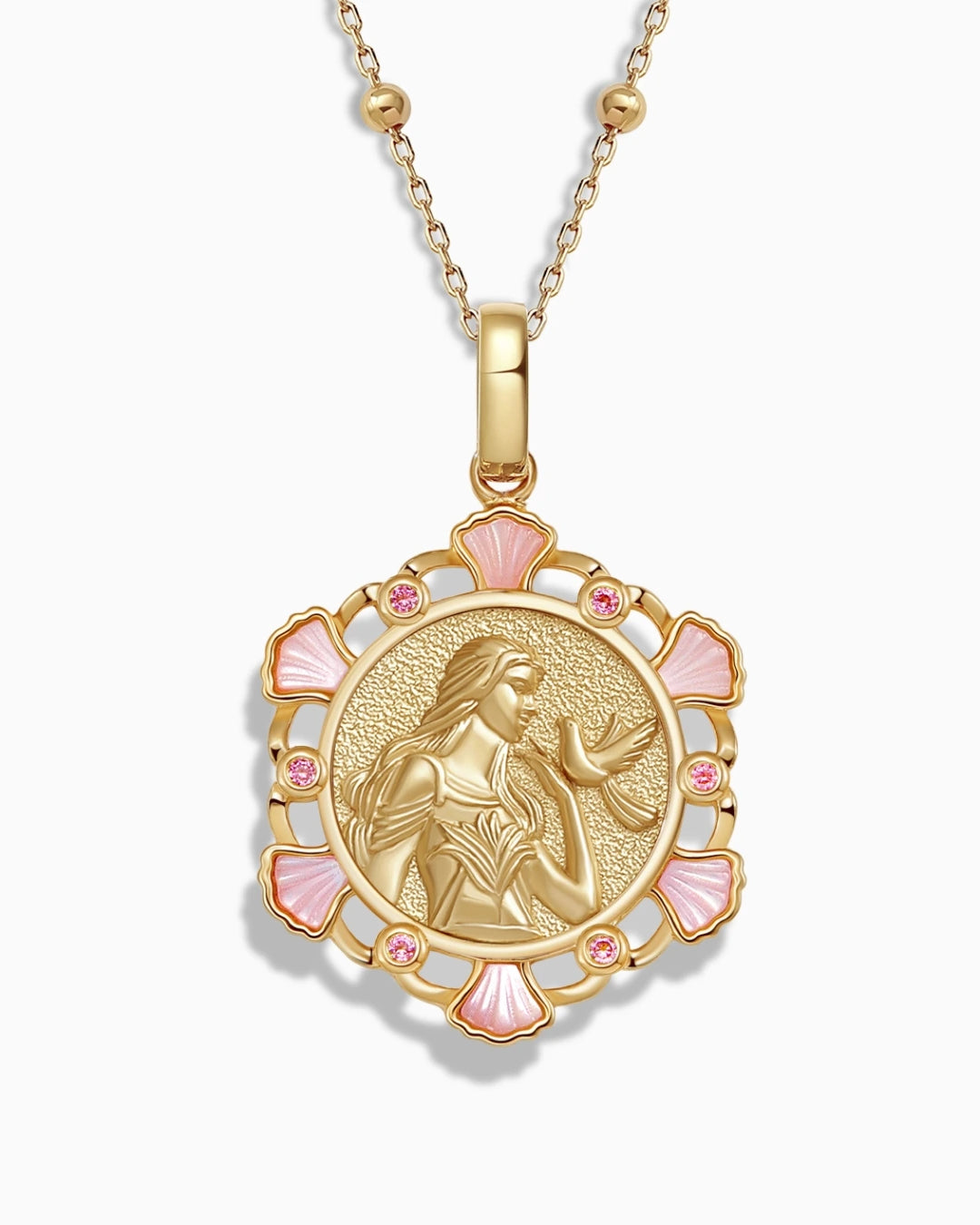
Look closely and you will see the story in the surface. The lines of the shell hold a language of emergence—layer by layer, the way the heart learns to open again. This is where rebirth becomes tangible.
7.1 Symbolism of the Sacred Shell
The Aphrodite Shell Necklace draws directly from one of the most enduring symbols in her myth: the sacred shell. Emerging from the sea alongside Aphrodite herself, the shell represents a threshold between inner and outer worlds. It carries the memory of protection, gestation, and quiet becoming. As an adornment worn close to the heart, the shell supports a return to emotional purity—not as innocence, but as clarity free from distortion, shame, or self-betrayal.
Crafted with mother-of-pearl, the necklace reflects light in soft, layered tones that shift with movement. This responsiveness mirrors the emotional and creative body, gently encouraging flow rather than control. As the heart center stabilizes, creative energy begins to circulate again. Expression feels safer. Inspiration returns without pressure. Love, beauty, and creativity emerge from the same open field of feeling, each reinforcing the other through embodied presence.
Explore the Aphrodite Shell Necklace here: https://vidawheel.com/collections/aphrodite-goddess/products/aphrodite-shell-necklace
7.2 Affirmation for Your Amulet
This meditation can be practiced in 3–7 minutes. It works best when repeated regularly rather than performed once with intensity.
Begin by sitting or standing comfortably. Wear the Aphrodite Shell Necklace and allow it to rest naturally against your chest. Bring one hand to the area of the heart, lightly touching the shell or feeling its weight through the fabric.
Take three slow breaths. With each exhale, allow the shoulders to soften and the jaw to release. There is nothing to achieve in this moment. Let attention settle into physical sensation—the warmth of the body, the rhythm of breath, the presence of the necklace.
As the breath finds its own pace, silently repeat the following affirmation, once or several times, without force:
“I allow myself to be loved.
I allow myself to bloom.”
Let the words land not in the mind, but in the body. Notice any subtle response—warmth, expansion, resistance, or emotion. There is no need to change what arises. Simply allow it to move.
If it feels natural, imagine the heart opening at its own speed, like a shell responding to light and water. Not opening fully, not closing—just adjusting. Remain with this sensation for a few breaths.
To close the practice, gently lower your hand and return attention to the room. Carry the feeling with you as you move, letting the necklace continue the work through quiet presence.
8. Deep Dive: The Aphrodite Blooming Necklace – Unstoppable Radiance

The
Aphrodite Blooming Necklace represents a later movement within the Aphrodite journey. Where the Shell Necklace supports reopening and emotional safety, the Blooming Necklace reflects expansion—an outward radiance that grows naturally from inner fullness. This is not a sudden transformation, but the visible result of sustained emotional honesty, creative circulation, and self-trust. Blooming begins inside the body and gradually extends into presence, expression, and influence.
The Blooming design emphasizes light, openness, and upward movement. Worn close to the heart, it reinforces a sense of continuity between inner alignment and outer action. As emotional energy stabilizes and desire finds healthy expression, confidence becomes less performative and more grounded. Radiance emerges as a byproduct of coherence, not effort. The necklace supports this phase by offering consistent physical feedback, reminding the wearer of the connection between what is felt internally and how it is carried into the world.
8.1 The Energy of Blooming
Blooming describes the phase when inner nourishment begins to move outward. Emotional openness supports creativity, creativity feeds expression, and expression expands influence. In this stage, desire no longer circles inward as longing or self-questioning. It flows forward as action, voice, and presence. The Aphrodite Blooming Necklace accompanies this movement, supporting a steady rhythm in which inner fullness translates into visible impact without depletion.
8.2 A Gift for the Evolving Soul
The Aphrodite Blooming Necklace is often chosen as a marker of transition. It is a gift to oneself after a period of inner work—after moving through emotional contraction, shadow integration, or the release of old identities. Rather than symbolizing completion, it honors continuity. It acknowledges growth that has already taken place and supports the next phase of expression. As a self-gift, it affirms worth without external validation, recognizing radiance as something cultivated and lived.
| Feature |
Aphrodite Shell Necklace |
Aphrodite Blooming Necklace |
| Core Energy |
Receptive · Healing · Emotional Safety |
Expressive · Radiant · Creative Expansion |
| Archetypal Phase |
Softening and reopening the heart after protection or withdrawal |
Embodying confidence and influence after inner integration |
| Recommended For |
Women transitioning from Artemis to Aphrodite, ready to feel again and receive love |
Women ready to express desire, creativity, and presence in work, relationships, or visibility |
| Primary Support |
Emotional regulation, heart-opening, creative reawakening |
Expression, confidence, creative flow, outward impact |
| Ritual Alignment |
Evening rituals, sensual bathing, heart-centered meditation |
Mirror affirmations, creative writing, intentional self-expression |
| Living Rhythm |
Supporting safety, softness, and emotional permission |
Supporting momentum, visibility, and sustained radiance |
| Call to Action |
Shop Shell Necklace |
Shop Blooming Necklace |
9. Integrating Aphrodite into Your Life: Healing Practices
Integrating Aphrodite into daily life happens through simple, repeatable actions that engage the body, the senses, and emotional truth. These practices are designed to create a living atmosphere of freedom—one that is reinforced through touch, scent, rhythm, and shared presence. Jewelry, ritual materials, and community work together to keep Aphrodite energy active beyond moments of reflection.
9.1 Mirror Affirmations and Sensual Bathing
Stand in front of a mirror while wearing your Aphrodite necklace. Place one hand over the heart and take two slow breaths. Allow the body to settle without adjustment. If desired, apply a light mist of rose water to the chest, neck, or wrists. Rose supports emotional softening and heart awareness through scent and sensation.
Gently repeat the affirmation:
“I allow myself to be loved.
I allow myself to bloom.”
Pause and notice any response in the body. Let sensation lead rather than interpretation.
Sensual Bathing Ritual (10–20 minutes)
Prepare warm bath water. Dissolve a small amount of pearl powder into the water, allowing it to turn soft and milky. Pearl has traditionally been used externally to calm the skin, soothe the nervous system, and support a sense of inner luminosity. Add rose petals or a few drops of rose essential oil if desired.
Light a candle to mark the transition into a slower rhythm. During the bath, place your Aphrodite necklace nearby or wear it if appropriate, letting it act as a physical anchor. Bring attention to texture, warmth, and the way the body responds to being held by water.
After bathing, allow the skin to air dry briefly. If journaling feels natural, write a few lines about what shifted—without analyzing or naming outcomes.
9.2 Connecting with the Sisterhood
Aphrodite energy stabilizes through shared experience. Within sisterhood spaces such as Queendom.She, simple collective practices deepen emotional safety. Group mirror affirmations, rose-scented breathing, or shared writing prompts help normalize expression and vulnerability.
One effective practice involves pairing women to witness one another for two minutes each—no advice, no feedback, only presence. Wearing Aphrodite necklaces during these moments reinforces a sense of continuity between personal practice and relational space. Over time, sisterhood becomes a living mirror where radiance grows through resonance rather than comparison.
10. FAQ: Navigating Your Goddess Journey
-
How do I know if my Aphrodite energy is blocked?
Aphrodite energy may feel blocked when pleasure feels unsafe, emotions are muted, or creativity feels distant. You may notice a tendency to over-function, self-censor desire, or seek validation instead of resonance. These signs point to protection rather than failure, inviting gentle reconnection rather than forceful change.
-
Can I wear Aphrodite jewelry if I identify as an Artemis type?\
Yes. Many women resonate with Artemis energy during periods of independence and self-protection. Aphrodite jewelry does not negate this strength. It supports softening and receiving alongside autonomy, allowing intimacy and sensation to return without compromising boundaries or self-trust.
-
How do I cleanse my Vidawheel amulet?
Cleansing can be simple and intuitive. Place your amulet in moonlight, near a candle, or beside rose petals for a few minutes. Touch it with intention, allowing breath and presence to reset its rhythm. Consistency matters more than ritual complexity.
-
How can I balance Aphrodite Goddess energy with my career goals?
Aphrodite energy enhances career paths by supporting creativity, presence, and authentic expression. Balance comes from allowing feeling to inform action rather than override structure. When emotional truth and professional intention align, productivity becomes sustainable and influence grows without depletion.
-
How does Vidawheel support the empowerment of every Aphrodite Goddess?
Vidawheel supports empowerment through embodied practices, sacred adornment, and community resonance. Rather than prescribing identity, it offers tools that help women reconnect with emotional sovereignty, creativity, and self-trust, allowing Aphrodite energy to unfold uniquely within each life.